WHO WATCHES THE WATCHERS? THE SOCIAL HOUSING REGULATOR, THE REVOLVING DOOR, AND A SCANDAL HIDING IN PLAIN SIGHT
Updated: Sep 2

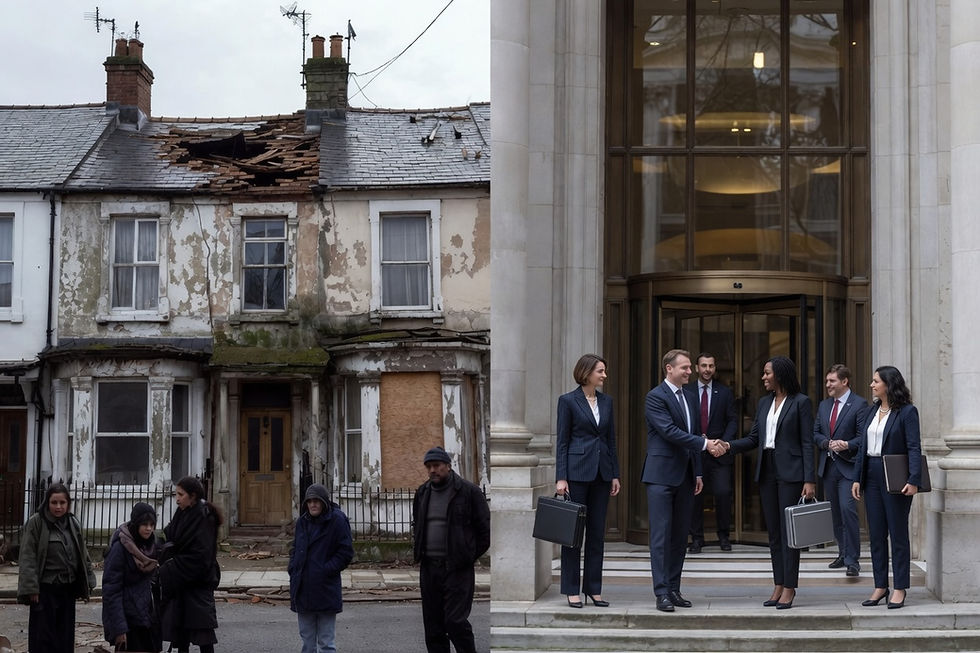
This is the first in a series of articles on a matter of profound public interest: the conduct of the body responsible for regulating social housing in England. The evidence gathered over many years points to systemic corruption, conflicts of interest, discriminatory conduct, and — most gravely — serious harm to some of the most vulnerable tenants in the country. Formal referrals have now been made to the regulator, to the police, and to senior oversight bodies. This matter is live and ongoing.
The Scale of What Is At Stake
Social housing in England is not a minor policy footnote. The sector is valued at over £200 billion and receives enormous quantities of public money. Housing associations alone reinvested a record £14.8 billion in a single year. Millions of people — many elderly, disabled, or on very low incomes — depend on this sector for safe, decent homes.
The body charged with overseeing all of this is the Regulator of Social Housing (RSH). Its stated mission is to ensure housing associations are well-governed, financially viable, and delivering good outcomes for tenants.
What happens when the regulator itself is the problem? Who watches the watchers?
________________________________________
The Revolving Door: When the Watchdog Becomes Part of the Pack
Over a period of decades, a pattern has emerged that is deeply troubling. Senior officials within the RSH and its predecessor bodies — the Housing Corporation, the Tenant Services Authority, and the HCA Regulation Committee — have moved with striking regularity into senior roles at the very housing associations and consultancies they previously regulated. Others have moved in the opposite direction, from the sector into the regulator.
This is not merely a matter of career progression. In several documented cases, these movements occurred in close proximity to significant regulatory decisions affecting the organisations involved. The result has been a perception — supported by evidence — of a protected network operating to mutual advantage, with certain organisations enjoying notably lenient treatment while others were subjected to treatment that can only be described as disproportionate.
The questions this raises are not hypothetical. They go to the integrity of a public institution responsible for billions of pounds of public money.
________________________________________
Disparate Treatment: Two Standards of Regulation
The evidence reveals a deeply troubling pattern of regulatory double standards.
On one side: organisations with serious, prolonged, and documented failings — including actual harm to tenants — received what can only be described as collaborative and protective treatment. Governance downgrades, where they occurred, were accompanied by long recovery timescales, acceptance of voluntary undertakings, and no consequences for leadership. Chief executives remained in post. Mergers were facilitated. Business continued largely as usual.
On the other side: at least one housing organisation with an exemplary, award-winning record — low risk ratings, high tenant satisfaction, unbroken safety accreditations, and independent confirmation of good governance — was subjected to years of intensive, overlapping scrutiny without regulatory justification. This culminated in a sudden governance downgrade, unlawful pressure on its board, and the manufactured departure of its long-standing chief executive.
Within days of that departure, the organisation's entire brand, history and identity were erased. Decades of community trust, built painstakingly at a local level, were dismantled almost overnight.
This is not the conduct of a regulator applying consistent, evidence-based standards. It is the conduct of an institution that had a predetermined agenda — an agenda that had nothing to do with tenant welfare or regulatory compliance.
________________________________________
Internal Evidence of Discrimination
Perhaps the most disturbing element of this story concerns what the regulator's own internal records reveal.
Documents obtained through a Subject Access Request under the Data Protection Act 2018 disclose a pattern of internal commentary about the leader of the targeted organisation that is wholly irrelevant to any legitimate regulatory purpose. References to his faith, to his church involvement, and to his ethnic heritage appear repeatedly in internal communications spanning many years.
During one inspection, staff and board members were asked directly: "Is [the chief executive] a Christian?" and "Do you have to be religious to work here?"
These are not regulatory questions. They are evidence of animus — of prejudice operating within a public institution and being directed against an individual on the basis of protected characteristics. Under the Equality Act 2010, this is unlawful. Under any reasonable standard of public life, it is disgraceful.
The Nolan Principles require those in public life to act with objectivity, accountability, and integrity. The evidence from within the RSH's own files suggests that, in this case, those principles were abandoned entirely.
________________________________________
The Grenfell Context: Why This Matters Beyond One Case
On 19 May 2026, the Metropolitan Police announced they are seeking criminal charges against up to 57 individuals and 20 organisations in connection with the Grenfell Tower fire, which killed 72 people.
The Grenfell Tower Inquiry exposed something that resonates directly with the concerns set out in this article: a regulator that failed to act on serious safety concerns; an institution that dismissed the voices of vulnerable tenants; a culture of deference to large, well-connected organisations; and the catastrophic human consequences that follow when accountability is sacrificed to institutional self-interest.
Survivors and bereaved families stated after the Metropolitan Police announcement:
"There is a complete breakdown in trust and confidence. We no longer have faith in the institutions responsible for delivering accountability."
Those words carry a weight that extends far beyond Grenfell. They speak to what happens when regulators protect themselves and their networks rather than the people they are mandated to serve.
The RSH's documented pattern of disparate treatment, revolving-door relationships, and discriminatory conduct raises a direct and legitimate question: were similar cultural and structural weaknesses shaping its approach to safety and tenant welfare more broadly?
________________________________________
The Regulator's Response: "Nothing to See Here"
In April 2026, a detailed, evidenced formal letter was submitted to the RSH's Chief Executive and Chief Executive Designate, supported by six annexes of documentary evidence. Copies were sent to the RSH Chair, the Permanent Secretary at the Department for Levelling Up, Housing and Communities, the Minister for Housing and Planning, and the Chair of the Housing, Communities and Local Government Select Committee.
The RSH's response, issued on 13 May 2026, is a masterclass in institutional evasion. Despite receiving detailed, referenced evidence running to multiple annexes, the RSH replied that it "cannot identify any specific matters for consideration."
It stated that the concerns raised "would be confidential and refer to named individuals" — as if accountability for public officials in public roles could legitimately be refused on grounds of confidentiality.
This position is untenable. Every item of evidence submitted was already in the public domain. The identification of individuals who hold or have held senior public roles is not only legitimate but necessary when concerns about misconduct in public office are being raised. To suggest otherwise is to place the regulator beyond meaningful scrutiny — which is, of course, precisely the point.
A formal Stage 1 Complaint was lodged on 20 May 2026. The RSH has acknowledged it and committed to a response by 15 July 2026. That response will be published here in full.
________________________________________
The Police Referral
Given the RSH's refusal to engage, a formal written referral has been made to West Yorkshire Police — the force covering the RSH's headquarters in Leeds. The referral sets out concerns of:
• Misconduct in Public Office by senior regulatory officials
• Fraud relating to public funds, where regulatory decisions appear designed to benefit certain connected individuals and organisations
• Conspiracy to pervert the course of justice or obstruct proper regulatory scrutiny
• Continuing risk to public safety and to the lives of vulnerable tenants
Copies of the referral have been sent to the Independent Office for Police Conduct (IOPC) and the Crown Prosecution Service (Specialist Fraud Division).
Referrals have also been made to other relevant oversight bodies. This matter is now in the hands of multiple investigative authorities.
________________________________________
The Wider Pattern: Medium-Sized Providers and the Politics of Absorption
There is a broader issue at work here that the public deserves to understand.
For decades, there has been a policy pressure — sometimes explicit, sometimes operating through regulatory incentive and disincentive — to consolidate social housing into ever-larger national entities. Locally accountable, community-rooted organisations, however effective, have been systematically disadvantaged.
The argument made in favour of consolidation was always about efficiency and financial resilience. What the evidence increasingly suggests is that this agenda also served the interests of a network of individuals who moved between the regulator, large housing associations, and the consultancies that advised them — and who stood to benefit, professionally and financially, from the absorption of smaller providers into the larger organisations they controlled or influenced.
When a well-run, award-winning local housing organisation can be regulatory destroyed without justification, and when its tenants subsequently suffer conditions that would have been unthinkable under its previous management, the question of who this agenda truly served demands an answer.
________________________________________
What I Am Asking For
The ancient question "Quis custodiet ipsos custodes?" — who guards the guardians? — has never been more relevant.
Public institutions that regulate on behalf of all of us must themselves be accountable. When they are not, it is the most vulnerable who pay the price.
I am calling for:
1. A full, substantive response from the RSH to the detailed concerns raised — not procedural deflection, but genuine engagement with the evidence
2. Independent investigation of the revolving-door relationships, conflicts of interest, and disparate regulatory treatment documented in the formal referral
3. Police investigation of potential Misconduct in Public Office and fraud relating to public funds
4. Parliamentary scrutiny through the Housing, Communities and Local Government Select Committee
5. Accountability for the harm done to the tenants whose lives were damaged by regulatory decisions that cannot be justified on any legitimate grounds
________________________________________
What You Can Do
This is a matter of public interest that affects every person who relies on — or contributes through their taxes to — the social housing sector.
• Write to your MP asking them to raise these concerns with the Housing, Communities and Local Government Select Committee and the Minister for Housing and Planning
• Share this article on every platform available to you
• Contact the Housing Ombudsman if you are a social housing tenant experiencing poor conditions or inadequate responses from your landlord
• Follow this series — further articles will document the evidence in greater detail as the complaints process and police referral progress
________________________________________


Comments