WHEN HERITAGE CHARITIES FORGET WHOSE HERITAGE IT IS
The National Trust, English Heritage, and a Charity Commission that Won't Act: A Story of Differential Treatment and Regulatory Failure
Two Charities, One Pattern
In the past twelve months, two of Britain's most prominent and heavily subsidised heritage charities have demonstrated, through their actions, that Christianity and Christians occupy a different — and lesser — place in their institutional thinking than other faith communities. And when I brought formal complaints to the regulator responsible for ensuring charities act within the law, I was told, in both cases, that there was nothing to see.
I believe that conclusion is wrong. And I believe the pattern these cases reveal deserves wider public attention.
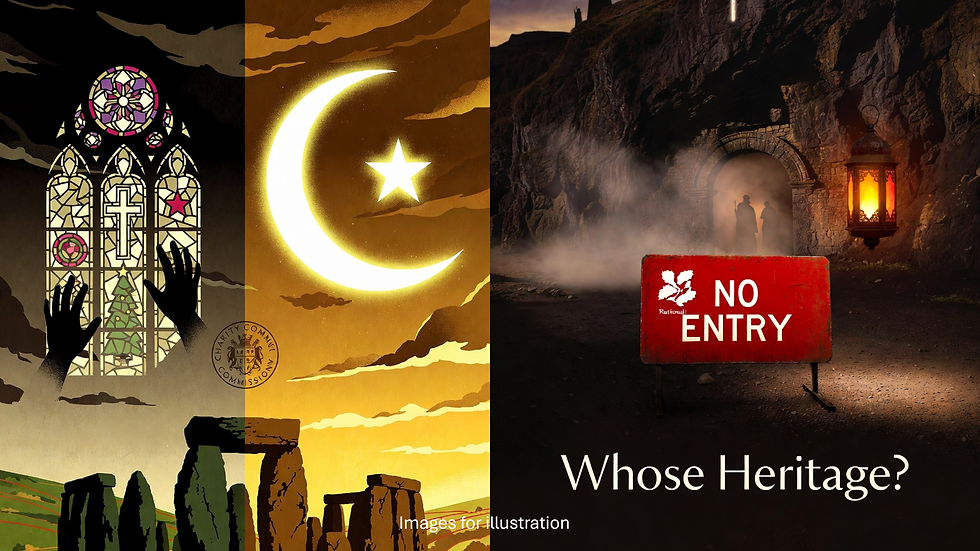
The National Trust and St Cuthbert's Cave
St Cuthbert's Cave is a site in Northumberland intimately connected with the life and legacy of St Cuthbert, one of the most significant figures in early British Christianity, whose remains were carried there by monks fleeing Viking raids in the ninth century. The site is managed by the National Trust.
In 2025, a request was made to film a Christian documentary at St Cuthbert's Cave. The National Trust refused — explicitly on the grounds of the project's religious affiliation.
This is the same National Trust that actively promotes and facilitates Ramadan retreats at Ilam Park and other faith-specific events at its properties. The contrast is not subtle. Filming a documentary about the Christian heritage of a site defined by its Christian heritage was refused. Events specifically associated with another faith were welcomed and promoted.
I submitted a formal concern to the Charity Commission in February 2026, citing potential breaches of the National Trust's public benefit obligations under the Charities Act 2011 and potential direct or indirect discrimination under the Equality Act 2010. The Commission replied on 17 February 2026, declining to act. It stated that it had not identified evidence that decisions had not been made lawfully. It also said that equality matters were the EHRC's responsibility, not the Commission's.
English Heritage and the Christmas 'Nonsense Theory'
In December 2025, English Heritage admitted to having disseminated material that its own representatives described as a 'nonsense theory' about the origins of Christmas. This material had the effect of systematically downplaying and obscuring the Christian foundations of one of the most important and widely celebrated observances in the British calendar. The story was corroborated by The Telegraph and the Christian Institute.
Christmas is not a contested matter of heritage. Its Christian origins are historical fact. A heritage charity that publishes material — acknowledged by its own staff to be false — which obscures those origins is not advancing heritage. It is distorting it.
I submitted a formal concern to the Charity Commission in February 2026. The Commission replied on 28 April 2026, two and a half months later, stating that it had found no wrongdoing, that the matter was an editorial one for the charity's trustees, and pointing me again to the EHRC for equality concerns.
The Charity Commission's Response — and Why It Falls Short
In both cases, the Commission's responses follow the same pattern: there is no evidence of unlawful conduct; the decisions were properly made; equality is the EHRC's territory, not ours.
I am contesting both decisions. The Commission cannot disclaim all responsibility for breaches of law that happen to involve equality legislation — its regulatory remit includes ensuring charities act within the law, and the Equality Act is part of the law.
The Commission's conclusion that it found no evidence of unlawful conduct appears to have been reached without any analysis of whether the charities' differential treatment of Christianity amounts to direct or indirect discrimination under sections 13 and 19 of the Equality Act 2010.
I have asked the Commission to review both decisions. I have written to the Equality and Human Rights Commission requesting it to consider whether the conduct described warrants investigation. I have written to Huntingdon MP, Ben Obese-Jecty, asking him to raise these matters in Parliament and with the Culture Secretary.
The Bigger Picture
These cases do not exist in isolation. They form part of a broader pattern, well documented in recent years, of major British institutions treating Christianity and Christians as somehow less deserving of respect, accommodation, and courtesy than other faith communities. That pattern is not merely unfair. It is a betrayal of the heritage these organisations claim to protect.
Britain's history — its art, its architecture, its literature, its law, its festivals and its communities — cannot be honestly told without Christianity at its heart. When the institutions charged with preserving and advancing that heritage treat its Christian dimension as a problem to be managed, explained away, or simply refused, they are not acting as the custodians of our heritage. They are acting as its curators of exclusion.
I will continue to press these matters through every appropriate channel. I will publish updates on this website as they develop.
If you share these concerns, I encourage you to write to your MP, to the Charity Commission, and to the EHRC.


Comments